


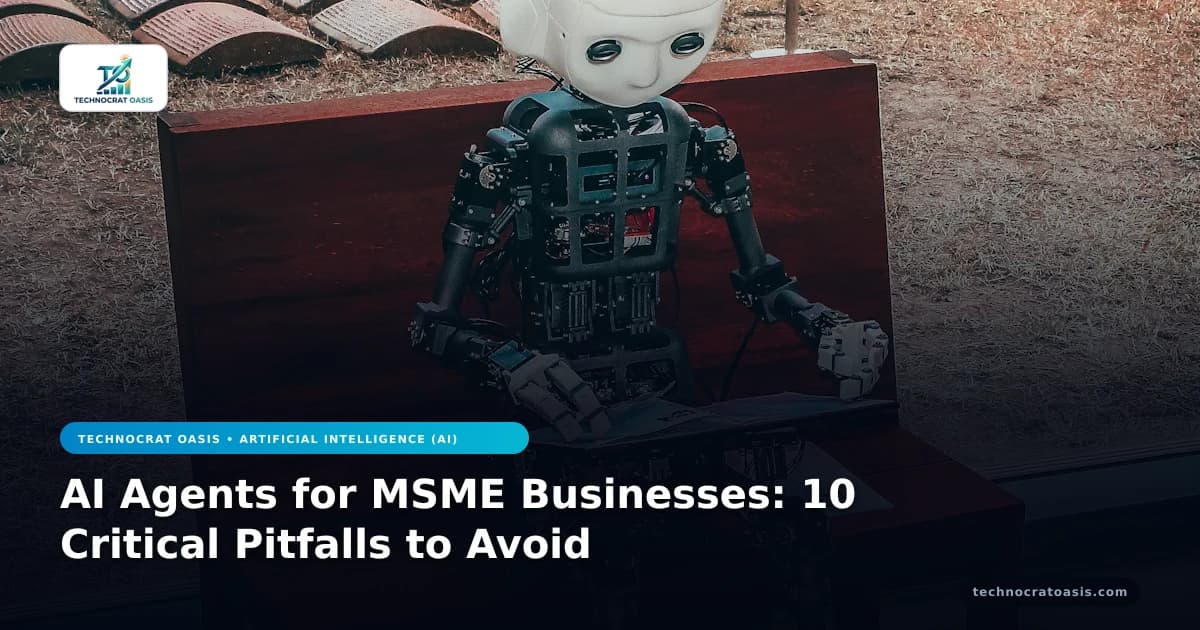
Navigating the Risk Landscape of Autonomous Automation
As regional enterprises and Micro, Small, and Medium Enterprises (MSMEs) rush to adopt intelligent automation, the race to gain a competitive advantage often overshadows critical governance protocols. Deploying autonomous tools without a structured oversight framework introduces massive operational, financial, and legal vulnerabilities. Utilizing AI Agents for MSME Businesses 10 Critical Pitfalls as your operational audit checklist ensures that your digital transformation accelerates growth rather than inviting disastrous system failures or severe compliance breaches.
While the allure of automated customer service, predictive inventory management, and automated bookkeeping is undeniable, local business owners must recognize that automated systems inherit human blind spots, scale data privacy infractions exponentially, and frequently break down without proper localized integration. This comprehensive guide highlights the ten most dangerous mistakes organizations make when deploying autonomous agents and outlines actionable steps to secure your systems, protect your customer data, and safeguard your bottom line.
1. Local Market & Regional Intent: Ignoring Jurisdictional Compliance
One of the most profound errors regional operators make is deploying generalized algorithms that fail to account for localized regulatory requirements. Whether you operate within strict state-level consumer privacy laws or specialized municipal commerce frameworks, your automated software agents must be configured to respect local statutes. For an in-depth understanding of how to structure your implementation timeline, consult our complete AI Agents for MSME Businesses guide.
Failing to map data collection practices to regional mandates can lead to severe fines. Autonomous text generators and customer-facing chat bots often inadvertently collect personally identifiable information (PII) without explicit, region-compliant consent. Ensuring your local data governance policies align with regional jurisdiction is not optional—it is a baseline survival requirement for modern enterprises.
2. Overlooking the Core AI Agents for MSME Businesses Process
Many regional organizations purchase off-the-shelf software packages and deploy them haphazardly across departments without establishing a formal deployment roadmap. This skips the essential discovery, testing, and validation phases. A structured workflow ensures that every automated trigger, API connection, and decision tree is thoroughly stress-tested before touching live customer environments.
- Step 1: Scope out the exact business bottleneck you intend to resolve.
- Step 2: Audit existing data repositories for cleanliness, accuracy, and bias.
- Step 3: Run sandbox simulations to measure autonomous error rates.
- Step 4: Deploy phased rollouts with continuous human-in-the-loop oversight.
3. Neglecting Proper Talent Acquisition: Why You Must Carefully Hire Experts
Attempting to implement complex automation stacks using internal staff with zero machine learning or data governance experience is a recipe for project failure. To achieve sustainable outcomes, business leaders must know how and when to hire AI Agents for MSME Businesses specialists who understand both regional commercial realities and advanced software engineering principles.
Without qualified oversight, organizations routinely suffer from 'hallucinating' algorithms that provide incorrect pricing, leak proprietary supplier data, or alienate key regional clients through tone-deaf, automated responses.
4. Misunderstanding the True AI Agents for MSME Businesses Benefits
Enterprise leaders frequently fall victim to vendor hype, expecting instant profitability and zero-touch operations from day one. Unrealistic expectations lead to premature abandonment of valuable automation projects when initial teething issues arise. A mature evaluation of the actual advantages reveals that true value stems from incremental efficiency gains, reduced human error in data entry, and scalable client communication.
To maximize these advantages without over-leveraging your operational budget, always align software capabilities with measurable Key Performance Indicators (KPIs) tailored to your regional market footprint.
5. Disregarding Essential Technical Requirements
Deploying cutting-edge software onto legacy hardware or fragmented, outdated cloud infrastructure introduces severe security vulnerabilities. Reviewing the fundamental AI Agents for MSME Businesses requirements helps avoid expensive infrastructure overhauls mid-project. Essential technical considerations include:
- Robust API rate-limiting to prevent unexpected cloud computing cost overruns.
- End-to-end encryption for data moving between local point-of-sale systems and cloud LLM endpoints.
- Granular role-based access control (RBAC) to restrict what internal operational data autonomous scripts can read.
- Comprehensive audit logging to track every automated decision made by the system.
6. Failing to Establish Human-in-the-Loop (HITL) Guardrails
Fully autonomous systems operating without human checks represent an unnecessary gamble. When an agent processes financial refunds, alters inventory pricing, or communicates directly with regulatory bodies, a human supervisor must review high-risk transactions. Implementing strict conditional gates ensures that software executes routine tasks while complex, sensitive decisions remain under executive control.
7. Underestimating Data Poisoning and Security Vulnerabilities
Autonomous models feed on input data. If your organization feeds unverified, dirty, or maliciously altered data into your models, the system's output integrity degrades instantly. Cybersecurity threats such as prompt injection attacks can manipulate customer-facing chat bots into divulging confidential business strategies or offering unauthorized discounts. Hardening your inputs through rigorous data sanitization protocols is critical.
8. Ignoring Vendor Lock-In and Scalability Bottlenecks
Many regional businesses sign restrictive contracts with proprietary software vendors, making it prohibitively expensive to migrate models or alter workflows as the enterprise grows. Always demand modular architecture and open standards where possible, ensuring your business retains complete ownership of your fine-tuned models, customer interaction histories, and proprietary prompt templates.
9. Regional Business Opportunities: Failing to Tailor for Local Niches
A generic implementation misses the nuance of local community engagement. Regional enterprises thrive on personalized relationships, local dialect understanding, and community-specific service offerings. Configuring your automated tools to reflect regional terminology and local business hours transforms cold, robotic interactions into warm, locally resonant digital touchpoints that drive high retention rates.
10. Neglecting Continuous Monitoring and Post-Deployment Audits
The journey does not end at deployment. Machine learning models drift over time as market dynamics, customer behaviors, and regulatory frameworks evolve. Establishing a monthly or quarterly audit schedule to review agent decision logs, error rates, and compliance adherence prevents small algorithmic drifts from compounding into major operational liabilities.
Local Partner Call-To-Action
Protecting your enterprise from costly mistakes requires expert guidance, localized strategy, and rigorous technical execution. Don't leave your digital transformation to chance. Partner with our team of regional specialists to build secure, compliant, and high-performing autonomous systems designed specifically for your market.
Ready to secure your automation pipeline? Explore our professional engineering and advisory services today to schedule your comprehensive risk assessment and discovery consultation.
