


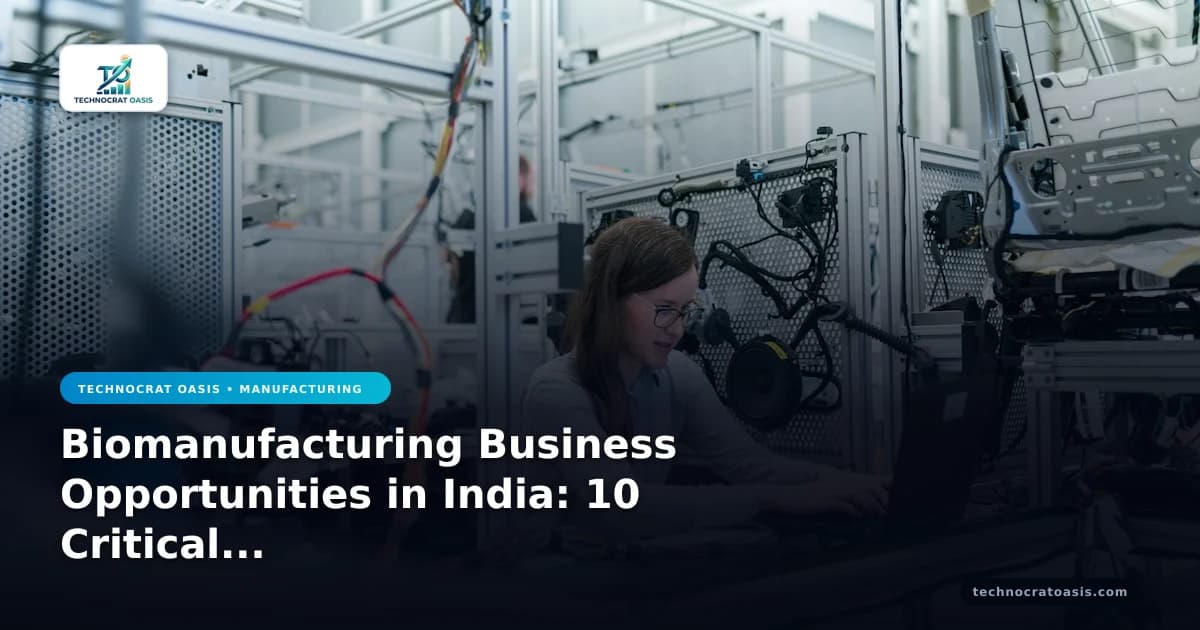
Navigating Biomanufacturing Business Opportunities in India: 10 Critical Pitfalls to Avoid
India stands as one of the most promising frontiers for biotechnology and biomanufacturing. With a robust talent pool, rapidly growing domestic healthcare markets, and massive government incentives, the sector is experiencing unprecedented acceleration. However, tapping into Biomanufacturing Business Opportunities in India 10 Critical Pitfalls requires extreme precision, careful planning, and deep localized insight. International and domestic investors often rush into this market underestimating complex regulatory hurdles, state-specific compliance requirements, and technical infrastructure bottlenecks.
This comprehensive guide details the top 10 critical pitfalls and compliance errors that derail biomanufacturing ventures, offering actionable prevention strategies to safeguard your capital and ensure long-term operational success.
1. Ignoring State-Specific Regulatory Variations
A common trap for new entrants is assuming that a single national approval covers all operational activities. While bodies like the Department of Biotechnology (DBT), the Genetic Engineering Appraisal Committee (GEAC), and the Central Drugs Standard Control Organization (CDSCO) set overarching national standards, state-specific pollution control boards (SPCBs) and municipal bodies hold immense jurisdiction.
- The Pitfall: Securing central clearances while failing to obtain state-level Consent to Establish (CTE) and Consent to Operate (CTO).
- Prevention: Partner with local legal and regulatory consultants early in the site-selection process to map out dual-layer compliance matrices.
2. Misinterpreting Environmental and Biosafety Guidelines
Biomanufacturing relies heavily on living organisms, recombinant DNA technology, and fermentation processes that generate biohazardous waste. Mishandling effluent treatment or containment protocols can result in immediate plant shutdowns and severe legal penalties.
- The Pitfall: Designing effluent treatment plants (ETPs) based on standard chemical manufacturing parameters instead of specialized biological oxygen demand (BOD) and chemical oxygen demand (COD) profiles unique to biotechnology.
- Prevention: Adhere strictly to the Revised Guidelines for Research in Recombinant DNA Safety issued by the DBT. Conduct rigorous pilot-scale testing before scaling up waste management infrastructures.
3. Underestimating the Complexities of the Biomanufacturing Business Opportunities in India Process
Many entrepreneurs treat setting up a bioplant like a standard warehousing or light-engineering project. The Biomanufacturing Business Opportunities in India process involves meticulous facility validation, cleanroom classification, cold-chain verification, and stringent Good Manufacturing Practice (GMP) alignment.
- The Pitfall: Rushing facility construction without integrated HVAC, sterile boundary mapping, or validation master plans (VMPs).
- Prevention: Build a phased project timeline that allocates adequate time for commissioning, qualification, and validation (IQ/OQ/PQ phases) before commercial manufacturing begins.
4. Failing to Secure Qualified Local Scientific and Technical Talent
While India boasts millions of STEM graduates, specialized bioprocess engineers, upstream/downstream operators, and validation experts with commercial-scale experience are in high demand and short supply.
- The Pitfall: Relying solely on remote technical oversight or undertrained local personnel to manage complex bioreactors and fermentation scales.
- Prevention: Establish continuous training partnerships with regional academic institutions and biotechnology parks to build a sustainable talent pipeline.
5. Overlooking Supply Chain and Cold-Chain Logistics Vulnerabilities
Biologics, enzymes, and cell cultures require unbroken cold chains and precise precursor inputs. Geographic disparities in infrastructure quality across different Indian states can create catastrophic supply chain failures.
- The Pitfall: Sourcing raw materials without verifying regional cold-chain redundancy, backup power reliability, and customs clearance speeds for specialized imported media.
- Prevention: Audit your entire tier-1 and tier-2 supply chain network prior to ground-breaking, ensuring dual-sourcing strategies for critical growth factors and reagents.
6. Inadequate Intellectual Property (IP) Protection and Data Integrity
Protecting proprietary strains, expression systems, and bioprocess parameters is vital. Entering joint ventures or outsourcing contract manufacturing without robust IP guardrails exposes companies to severe commercial risks.
- The Pitfall: Neglecting comprehensive non-disclosure agreements (NDAs) and technology transfer contracts governed by Indian patent laws.
- Prevention: Engage specialized legal counsel experienced in Indian patent jurisprudence and data exclusivity norms to secure your innovations before sharing technical packages with local partners.
7. Miscalculating Capital Expenditure (CapEx) and Operational Expenditure (OpEx)
Cost overruns are frequent in biotechnology infrastructure development due to fluctuating equipment import duties, specialized utility requirements (WFI - Water for Injection, Clean Steam), and lengthy regulatory approval cycles.
- The Pitfall: Failing to budget for recurring validation audits, calibration cycles, and unexpected utility modifications demanded by changing safety inspectors.
- Prevention: Maintain a 20% contingency fund specifically designated for regulatory modifications and extended validation timeframes.
8. Neglecting Local Stakeholder Engagement and Community Relations
Biomanufacturing facilities, particularly those involving fermentation or large-scale biomass processing, require harmonious relationships with local municipal communities and industrial clusters.
- The Pitfall: Ignoring community concerns regarding odor, waste disposal, and environmental safety until protests or local administrative stoppages occur.
- Prevention: Implement transparent community outreach programs, publicize environmental monitoring data, and engage in proactive corporate social responsibility (CSR) initiatives within your chosen industrial zone.
9. Overlooking Government Incentives and Subsidies
India’s central government and various state administrations (such as Telangana, Karnataka, Maharashtra, and Gujarat) offer lucrative capital subsidies, tax holidays, and power tariff concessions for biotechnology parks and manufacturing units.
- The Pitfall: Paying full market price for land, utilities, and capital equipment without applying for regional biotech-specific industrial promotion schemes.
- Prevention: Conduct a thorough review of state-level industrial policies and work with local economic development agencies to file subsidy applications concurrently with facility planning.
10. Skipping Expert Advisory When Evaluating Biomanufacturing Business Opportunities in India Benefits
Attempting to navigate the Indian regulatory, fiscal, and operational landscape entirely in-house often leads to costly blind spots.
- The Pitfall: Assuming global standard operating procedures (SOPs) can be directly copy-pasted into an Indian operational framework without localization.
- Prevention: Hire Biomanufacturing Business Opportunities in India advisory and engineering partners who possess proven, on-the-ground experience in bridging international standards with domestic regulatory mandates.
Summary Table: Key Pitfalls & Mitigation Strategies
| Critical Pitfall | Potential Impact | Strategic Prevention |
|---|---|---|
| Ignoring State Regulations | Plant shutdowns, legal fines | Engage local legal consultants for dual-layer compliance. |
| Flawed ETP Design | Environmental clearance denial | Use specialized biological oxygen demand (BOD) parameters. |
| Talent Shortage | Operational inefficiencies | Partner with regional biotech universities for training pipelines. |
| Ignoring Subsidies | Unnecessary capital expenditure | Audit state-specific biotech promotion schemes early. |
Conclusion
The roadmap to establishing a successful biomanufacturing enterprise in India is rich with high-yield opportunities, provided that organizations remain vigilant against regulatory, technical, and operational pitfalls. By understanding these 10 critical challenges and implementing robust, proactive prevention strategies, your business can unlock the immense potential of the Indian biotechnology sector with confidence.
Ready to accelerate your expansion securely? Explore our specialized advisory and engineering support to ensure your venture meets every compliance milestone seamlessly. Visit our services page today to learn how our regional experts can partner with your growth journey.
