


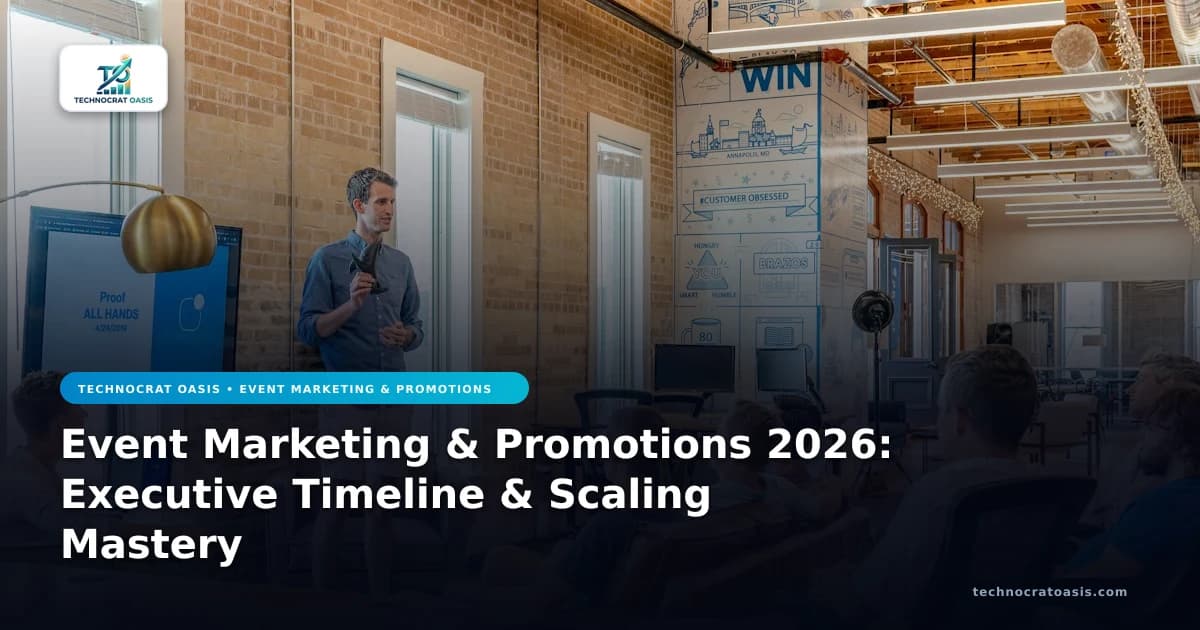
Introduction to Executive Event Marketing & Promotions in 2026
Corporate events are no longer just social gatherings or passive product showcases; they are high-stakes, revenue-generating engines that demand rigorous executive execution. In 2026, the convergence of experiential marketing, automated digital workflows, and data-driven attendee attribution requires enterprise leaders to treat every event as a core component of their annual growth strategy. Whether you are launching a category-defining product, orchestrating a high-profile industry summit, or scaling a global trade show presence, leaving your timeline, registration pipelines, and promotional milestones to chance will result in missed revenue targets.
This executive playbook provides founders, CXOs, and marketing directors with a comprehensive roadmap for mastering Event Marketing & Promotions executive strategy roadmap 2026. From compliance and budgeting to omnichannel amplification and post-event monetization, we break down the exact operational frameworks required to maximize enterprise return on investment (ROI).
Executive Summary & Key Takeaways
- Strategic Alignment: Treat events as top-of-funnel customer acquisition channels backed by precise KPIs, not auxiliary marketing expenses.
- Rigorous Timelines: Enterprise event execution requires a 6-to-12-month runway covering pre-launch compliance, ticketing workflows, and multi-channel amplification.
- Omnichannel Scaling: Combine high-impact experiential activations with targeted digital paid campaigns, influencer partnerships, and localized PR outreach.
- Data Attribution: Leverage advanced lead capture tools and CRM integrations to track immediate pipeline velocity and long-term customer lifetime value (LTV).
Eligibility Framework & Compliance Document Checklist
Executing large-scale corporate events, trade shows, and public activations requires strict adherence to legal, regulatory, and venue-specific compliance frameworks. Skipping critical administrative prerequisites can lead to severe fines, public relations crises, or outright event cancellation.
Before launching your promotional campaigns or opening registration portals, executive teams must verify regulatory compliance, secure necessary permits, and establish robust vendor agreements. Below is an exhaustive document and compliance checklist designed for enterprise-grade event operations.
Enterprise Event Compliance Matrix
| Compliance Category | Required Documentation / Permit | Operational Deadline | Responsible Department |
|---|---|---|---|
| Venue & Safety | Municipal Fire Safety Clearance, Occupancy Permits, Crowd Control Plan | 90 Days Prior to Event | Operations / Legal |
| Intellectual Property | Trademark clearances for event branding, music licensing (ASCAP/BMI or local equivalents) | 120 Days Prior to Event | Legal Counsel |
| Financial & Tax | GST/VAT registration for ticket sales, entertainment tax exemptions, vendor withholding tax filings | Ongoing / 60 Days Prior | Finance / Accounting |
| Data Privacy | GDPR/CCPA compliant attendee data collection policy, waiver forms for media recording | Prior to Ticket Launch | IT / Legal Compliance |
| Sponsorships & Grants | Co-branding agreements, government subsidy compliance documentation (if applicable) | 180 Days Prior to Event | Business Development |
For organizations seeking official guidance on corporate compliance and venture governance, consult resources such as the Ministry of Corporate Affairs or national enterprise portals to ensure all corporate structuring aligns with your event activities.
Step-by-Step Implementation Roadmap
A successful event marketing and promotions campaign follows a disciplined, phased chronological roadmap. Below is the operational execution framework used by top-tier enterprises to scale event visibility and attendee conversion.
Phase 1: Ideation, Strategic Alignment & Budgeting (Months 9-12 Out)
- Define primary business objectives: Lead generation, brand repositioning, customer retention, or direct product sales.
- Establish the overarching event theme, value proposition, and target audience persona profiles (CXOs, technical buyers, industry influencers).
- Allocate capital budgets across venue procurement, experiential production, paid digital promotions, and contingency reserves.
- Secure internal executive buy-in and establish key performance indicators (KPIs) such as Cost Per Acquisition (CPA) and Pipeline Generated.
Phase 2: Infrastructure Setup & Registration Engineering (Months 6-8 Out)
- Deploy robust Event Marketing & Promotions registration online portals with seamless mobile checkout experiences and automated confirmation workflows.
- Configure secure payment gateways, tiered ticketing options (Early Bird, VIP, General Admission), and automated invoice generation.
- Integrate registration forms directly with your enterprise CRM (e.g., Salesforce, HubSpot) to enable real-time lead scoring and automated segmentation.
- Develop the master event website optimized for search engines, featuring speaker bios, agenda schedules, and sponsor showcases.
Phase 3: Omnichannel Amplification & Promotion (Months 3-5 Out)
- Launch targeted Event Marketing & Promotions fees and process 2026 transparency campaigns to build trust with potential attendees and corporate sponsors.
- Execute multi-channel digital acquisition campaigns utilizing LinkedIn Ads, Google Search, and industry-specific programmatic display networks.
- Activate influencer partnerships, securing industry thought leaders to host panels, write guest posts, and promote ticket sales to their proprietary audiences.
- Deploy public relations (PR) outreach to secure media coverage in prominent trade publications, business journals, and tech blogs.
Phase 4: On-Site Execution & Experiential Activation (Event Days)
- Execute professional stage production, high-impact branding setups, and interactive booth designs.
- Deploy dedicated on-ground lead capture mechanisms, including RFID badges, QR-code scanning kiosks, and mobile lead-retrieval apps.
- Monitor real-time engagement metrics, session attendance rates, and live social media sentiment to dynamically adjust promotional pushes.
Phase 5: Post-Event Analytics & Revenue Attribution (Post-Event +30 Days)
- Ingest all on-site lead data into your CRM and initiate automated, personalized nurturing sequences within 24 hours of event closure.
- Analyze attendee feedback surveys, session ratings, and net promoter scores (NPS) to evaluate experiential quality.
- Calculate final ROI, comparing total expenditure against closed-won revenue, pipeline velocity, and brand lift metrics.
Cost Analysis, Subsidies & ROI Breakdown
Enterprise event budgeting requires a granular understanding of fixed versus variable costs, alongside potential external funding mechanisms. Many organizations overlook government grants, industry export promotion subsidies, and cooperative co-marketing funds that can significantly offset event production expenditures.
Financial Structure & Budget Allocation Comparison
| Expense Head | Typical Budget Share | Cost Optimization Strategy | Potential Subsidies / Grants |
|---|---|---|---|
| Venue & Technical Production | 35% - 45% | Multi-year venue contracts, hybrid virtual-physical formats to reduce physical footprint. | State-level tourism and convention promotion grants. |
| Digital & Omnichannel Promotion | 20% - 25% | Data-driven programmatic ad spend, organic SEO, and strategic media barter agreements. | MSME digital adoption schemes and export promotion councils. |
| Speaker Fees & Talent | 15% - 20% | Leverage reciprocal corporate partnerships, thought leadership exchanges, and panel formats. | None |
| Logistics, Hospitality & Staffing | 15% - 20% | Local staffing agencies, centralized hotel block negotiations, automated check-in kiosks. | None |
When evaluating financial structures, businesses should explore available enterprise support frameworks. For comprehensive guidance on leveraging business grants and financial schemes, review official resources via Startup India or your local economic development agency.
Critical Mistakes & Compliance Risk Prevention
Even seasoned marketing executives occasionally fall victim to operational oversights that jeopardize event success. Avoiding these pitfalls requires rigorous internal auditing and adherence to proven scaling frameworks.
Top 5 Pitfalls in Enterprise Event Marketing
- Late Promotion Launch: Initiating promotional campaigns less than 60 days prior to the event results in compressed sales cycles, inflated customer acquisition costs (CAC), and low ticket conversion rates.
- Neglecting Mobile Registration UX: Clunky, slow-loading registration forms cause immediate drop-offs. Your registration portal must support one-click mobile checkout and instant digital pass generation.
- Poor Data Integration: Capturing business cards or badge scans in isolation without direct CRM synchronization leads to delayed follow-ups and lost sales opportunities.
- Ignoring Regulatory Permits: Failing to secure municipal fire safety, sound amplification, or food and beverage licenses can lead to severe fines or event shutdowns on the day of production.
- Failing to Measure Post-Event ROI: Treating events purely as brand awareness exercises without tracking pipeline attribution makes it impossible to justify future event budgets to the board of directors.
To eliminate these risks and ensure seamless operational execution, partner with industry veterans who specialize in comprehensive event management. Explore our professional capabilities directly through our Event Marketing & Promotions Services.
High-Intent Frequently Asked Questions
1. What is the ideal timeline to begin planning an enterprise event or product launch?
For large-scale enterprise events, conferences, or product launches, you should initiate strategic planning and budgeting 9 to 12 months in advance. This ensures optimal venue availability, sufficient runway for multi-channel promotional campaigns, and thorough compliance preparation.
2. How do I optimize online registration conversion rates for corporate events?
Optimize online registration by minimizing form fields, utilizing fast mobile-responsive checkout workflows, offering tiered pricing incentives (e.g., Early Bird discounts), and integrating secure, trusted payment gateways to reduce friction and cart abandonment.
3. What compliance documents are mandatory when hosting a large public event?
Mandatory documents typically include municipal fire safety clearances, building occupancy permits, sound amplification licenses, local tax registration (GST/VAT) for ticket sales, and GDPR/CCPA-compliant data collection and media release waivers.
4. Are there government subsidies or grants available for business event marketing?
Yes, many regional and national governments offer export promotion grants, MSME digital marketing subsidies, and convention tourism development funds that partially reimburse qualifying event promotion and exhibitor expenses.
5. How can I accurately measure the ROI of my event marketing campaigns?
Measure event ROI by tracking total event expenditures against closed-won revenue, pipeline velocity, cost per lead (CPL), and long-term customer lifetime value (LTV) captured via integrated CRM and lead-attribution workflows.
6. How do professional event marketing agencies handle on-site lead capture?
Professional agencies deploy advanced on-site technologies such as RFID badge scanners, mobile lead-retrieval applications, interactive digital kiosks, and instant CRM synchronization to ensure immediate, qualified lead follow-up.
Ready to Scale Your Brand Through High-Impact Events?
Eliminate logistical friction and maximize your enterprise ROI with our practitioner-led event marketing and promotional solutions.
Explore Event Marketing Services