


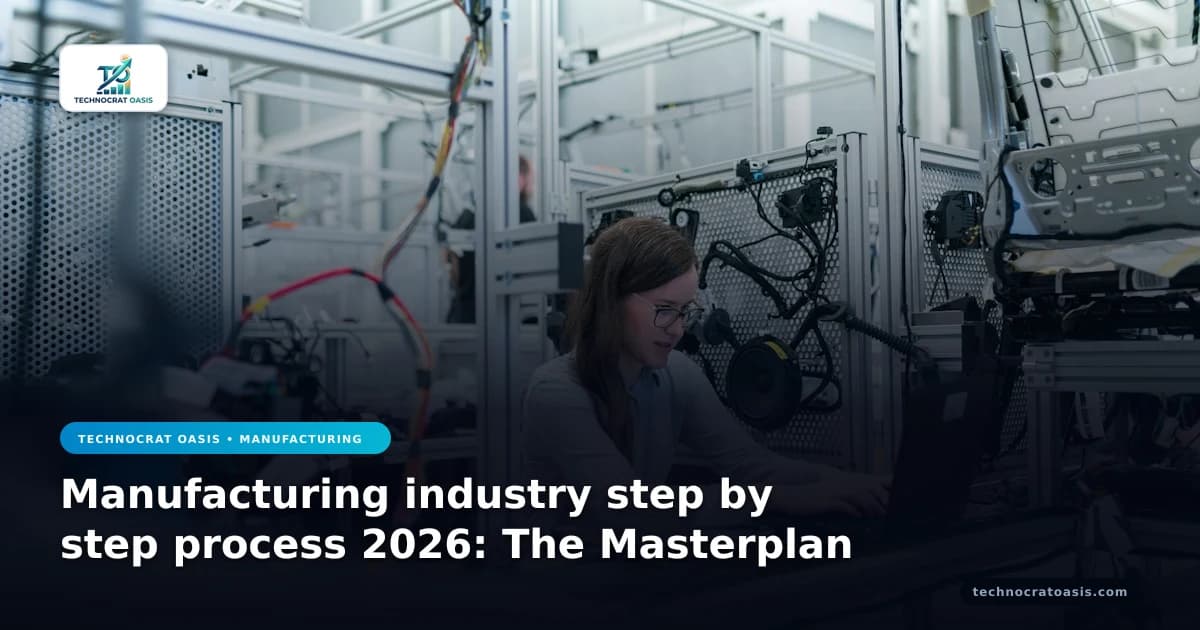
Executive Summary & Key Takeaways
The industrial sector stands at a historic crossroads. Supply chain volatility, soaring energy costs, and relentless consumer demand for hyper-customization mean that legacy, manual production floors are no longer viable. To survive and dominate in 2026, forward-thinking manufacturers must adopt an integrated digital strategy that unifies enterprise resource planning, IoT-driven predictive maintenance, and real-time inventory control.
This definitive guide provides an exhaustive, practitioner-level roadmap for founders, CXOs, and MSME owners looking to modernize operations, ensure rigorous regulatory compliance, and scale profitability. Whether you are establishing a new production facility or retrofitting a legacy plant with smart technologies, understanding this execution framework is critical.
- Digital Transformation Mandate: Siloed machinery and paper-based tracking create unacceptable bottlenecks; end-to-end software integration is non-negotiable.
- Step-by-Step Execution: Successful plant upgrades require a structured sequence spanning business registration, compliance licensing, ERP deployment, and IoT sensor calibration.
- Risk Mitigation: Strict adherence to environmental standards and data security protocols prevents costly shutdowns and heavy regulatory penalties.
- Measurable ROI: Implementing automated production scheduling and predictive maintenance typically slashes unplanned downtime by up to 35%.
For tailored digital infrastructure, explore our professional manufacturing software development services designed to accelerate your operational excellence.
Eligibility Framework & Document Checklist
Before deploying advanced manufacturing technologies or registering a new production unit, leadership teams must satisfy stringent statutory, environmental, and financial criteria. Establishing operational legitimacy requires a precise matrix of licenses, registrations, and technical audits.
The prerequisite framework ensures that industrial operations align with national safety codes, labor laws, and environmental protections. Below is the comprehensive compliance and documentation matrix required for industrial setups and technology integrations in 2026.
| Document / License Category | Issuing Authority / Governing Body | Mandatory Prerequisites & Purpose |
|---|---|---|
| Industrial License / MSME Registration | Ministry of Micro, Small and Medium Enterprises / State Directorate | Legal recognition of manufacturing activity, essential for accessing government subsidies, tax benefits, and institutional credit. |
| Environmental Clearance (EC) & Consent to Operate | State Pollution Control Board (SPCB) | Mandates adherence to waste management, emission thresholds, and effluent treatment norms before commissioning machinery. |
| Factory Building Plan Approval | Chief Inspector of Factories | Validates structural safety, ventilation, fire exits, and worker welfare infrastructure according to regional industrial acts. |
| GST & Import-Export Code (IEC) | Taxation & Customs Departments | Enables domestic interstate commerce and smooth procurement of specialized foreign machinery or raw materials. |
| IoT & Data Security Compliance Audit | Certified Cybersecurity Auditors | Ensures smart factory nodes and cloud-connected ERP endpoints comply with industrial data privacy and operational resilience frameworks. |
Step-by-Step Implementation Roadmap
Executing a comprehensive manufacturing upgrade requires a phased, chronological approach. Skipping steps or rushing deployment timelines inevitably leads to software friction, floor-level resistance, and costly production delays.
Phase 1: Strategic Assessment and Infrastructure Auditing
Begin by mapping existing operational bottlenecks. Evaluate current machinery throughput, inventory turnover rates, and legacy data silos. Establish precise Key Performance Indicators (KPIs) such as Overall Equipment Effectiveness (OEE) targets and acceptable defect rates.
Phase 2: Core Architecture and ERP Integration
Implement a robust Enterprise Resource Planning (ERP) platform to bridge the gap between shop-floor execution and top-floor financial management. Integrate procurement, production planning, warehouse control, and CRM workflows into a single unified dashboard.
Phase 3: IoT Sensor Deployment and Predictive Maintenance
Mount IoT sensors onto critical machinery—such as CNC mills, hydraulic presses, and conveyor motors—to stream real-time telemetry data. Deploy predictive maintenance algorithms that analyze vibration, temperature, and electrical draw to flag anomalies before mechanical failure halts production.
Phase 4: Workforce Training and Change Management
Technology is only as effective as the operators using it. Conduct intensive, hands-on training sessions for floor supervisors and machine operators using intuitive manufacturing mobile applications and digital twin simulations.
Phase 5: Continuous Optimization and Scalability
Leverage advanced analytics platforms to perform root-cause analysis on defect spikes or supply chain friction. Continuously refine production schedules and automated quality control loops to drive perpetual operational improvement.
Cost Analysis, Subsidies & ROI Breakdown
Investing in smart manufacturing software and physical infrastructure modernization requires careful capital allocation. While upfront expenditure for custom ERP development, IoT hardware retrofitting, and staff training can be substantial, government incentives and dramatic efficiency gains yield rapid payback periods.
Financial Comparison: Legacy Operations vs. Smart Manufacturing (2026)
| Operational Metric | Traditional Manual Operations | Smart Technology Integration |
|---|---|---|
| Average Unplanned Downtime | 15% to 22% of total operational hours | Under 4% via predictive IoT monitoring |
| Inventory Carrying Costs | High (Frequent overstocking and stockouts) | Optimized (Just-in-time automated tracking) |
| Defect Identification Rate | Post-production manual sampling (High waste) | Real-time automated computer vision inspection |
| Payback Period on Tech Investment | N/A (Constant margin erosion) | 12 to 18 months through waste reduction |
To offset initial setup costs, leverage government grants targeted at technology adoption, green energy transitions, and MSME digitalization. Combining these fiscal incentives with our specialized software solutions drastically lowers your net capital expenditure.
Critical Mistakes & Compliance Risk Prevention
Transitioning to a modern, digitized manufacturing paradigm is fraught with operational pitfalls. Avoiding these common mistakes safeguards your capital and protects your brand reputation.
- Ignoring Legacy System Interoperability: Attempting to bolt modern cloud software onto archaic, closed-architecture machinery creates severe data friction. Always insist on API-first, modular software design.
- Neglecting Cybersecurity Protocols: Connecting industrial IoT devices to the cloud without robust end-to-end encryption opens your plant floor to ransomware and corporate espionage. Prioritize zero-trust network architectures.
- Failing to Secure Environmental Clearances: Operating machinery without valid Consent to Operate (CTO) certificates can result in immediate facility seals and crippling statutory fines.
- Underestimating Change Management Resistance: Floor workers accustomed to clipboards and manual logs often reject new digital interfaces if proper, empathetic training is omitted.
Mitigate these risks by partnering with domain experts who understand the rigorous regulatory landscape and technical intricacies of industrial transformation.
High-Intent FAQs & Expert Consultation CTA
What are the primary benefits of implementing an ERP system in a manufacturing plant?
An enterprise resource planning (ERP) system unifies production scheduling, inventory control, procurement, and financial accounting. It eliminates data silos, reduces human error, provides real-time visibility into factory operations, and dramatically accelerates order fulfillment timelines.
How do IoT sensors reduce machine downtime in modern factories?
IoT sensors continuously monitor critical machine parameters such as vibration, heat dissipation, and acoustic resonance. Predictive maintenance software analyzes this data stream to detect micro-wear, allowing maintenance teams to service equipment proactively before catastrophic failure occurs.
What government schemes support MSME manufacturing digitization in 2026?
Governments worldwide offer capital subsidies, credit-linked capital subsidies, and zero-defect zero-effect (ZED) certification grants to help small and medium manufacturers adopt automation, cloud computing, and green technologies.
How long does it take to deploy a custom manufacturing software platform?
Deployment timelines vary based on plant complexity and scope. A modular rollout—starting with core ERP and inventory management followed by IoT integration—typically takes between 3 to 9 months for full enterprise-wide adoption.
Can legacy industrial machinery be integrated with modern smart factory platforms?
Yes. Legacy machines can be retrofitted with external IoT sensor kits, programmable logic controllers (PLCs), and edge computing gateways that translate analog machine signals into standardized digital protocols readable by modern cloud ERPs.
Ready to Transform Your Production Floor?
Stop letting operational inefficiencies and legacy bottlenecks erode your profit margins. Partner with Technocrat Oasis to deploy scalable, secure, and intelligent software solutions tailored to your production ecosystem. Visit our manufacturing solutions portal to schedule your technical consultation today.
